

The University of Michigan is committed to equitable access to education through supportive, inclusive academic practices that enable students to fulfill their academic requirements and honor their religious obligations. The university affirms each student’s right to observe their faith traditions and spiritual practices without academic penalty and is dedicated to supporting them through reasonable accommodation.
Guidelines
All faculty and students are expected to act in good faith to uphold the principles of religious inclusion and equitable access to academic success without intrusive inquiry. Different levels of observance exist within religious traditions. Religious accommodations are to be implemented in a timely, respectful, and confidential manner. Religious accommodations support, rather than conflict with, academic excellence and inclusive education.
Reasonable Accommodations
Reasonable accommodations that can be explored and implemented include but are not limited to:
- Rescheduling exams, presentations, or due dates.
- Excused absences with no academic penalty.
- Alternative assignments or flexible participation options.
- Modified exam times during fasting or holy periods.
- Faculty are not required to compromise essential academic standards but are expected to make equitable efforts to support students’ religious commitments.
Should an instructor and student be unable to reach agreement on a reasonable accommodation, the chair/director, dean or designee has the right to provide a reasonable accommodation appropriate to the circumstances.
Students

Photo courtesy of Kaley Joy, Office of University Development
Students who anticipate a conflict between academic requirements and religious observances should:
- Notify instructors in writing as early as possible and, when the calendar permits, no later than two weeks before the anticipated conflict.
- Provide their name, course number, the nature of the religious observance, specific dates impacted, and a brief request for accommodation.
- Students remain responsible for completing any missed coursework in coordination with faculty and within a mutually agreed timeline.
For further student resources and engagement opportunities please visit Religious, Secular and Spiritual Life at U-M.
Faculty

Photo courtesy of Marc-Gregor Campredon, Office of University Development
Reasonable accommodations that can be explored and implemented include but are not limited to:
- Rescheduling exams, presentations, or due dates.
- Excused absences with no academic penalty.
- Alternative assignments or flexible participation options.
- Modified exam times during fasting or holy periods.
- Faculty are not required to compromise essential academic standards but are expected to make equitable efforts to support students’ religious commitments.
Any questions or concerns should be directed to your department chair, the dean’s office, or the Registrar’s Office. You may also write to [email protected].
Official Academic Calendar
The University’s academic calendar as approved by the Board of Regents is posted on the Office of the Registrar website. The Final Exams schedule is also available from the Registrar’s website
Religious Holidays Calendar
The University of Michigan is home to a diverse community of students and a vibrant array of spiritual beliefs, practices, and expressions. Highlighted below are key observance dates for the academic year. While not exhaustive, this resource assists faculty in avoiding the scheduling of major exams, assignments, or required activities on dates that would be difficult or impossible to reschedule.
The calendar is currently under review and will be updated as part of work taking place in Winter 2026; however, it remains a useful reference in the interim. Faculty are encouraged to review the calendar when preparing syllabi and academic schedules. In general, it is best to consider individual needs rather than relying solely on blanket absence or grading policies.
[Add the religious holiday calendar to your personal Google calendar]
Religious Holidays during the 2025-26 Academic Year
This calendar is intended as a general resource and is not exhaustive. The absence of a religious observance from this calendar does not negate its significance or the need for appropriate consideration.
Many of the holidays listed below are linked to Fact Sheets prepared by a U-M School of Information Project Team with input and review from religious leaders and community organizations. The UMSI team members are Jacques Chestnut, Rebecca Epstein, Claudia Leo, James Reitz, Colum Slevin, Brian Schmidt, Barbara Smith (project lead), and Todd Stuart.
Most religions contain multiple sects, and even within a single sect – multiple practices around a holiday can be found. Authors of these Fact Sheets have attempted to generally describe an event that is likely celebrated in many different ways. If someone feels the authors have misrepresented any information or would like information added, they are open to feedback. Please email them to [email protected].
[Download 2025-26 holidays list]
2025-26 Holidays and Fact Sheets
- September 22-24 / Rosh Hashanah * (Jewish)
- October 1-2 / Yom Kippur * (Jewish)
- October 6-13 / Sukkot * (Jewish)
- October 13-15 / Shemini Atzeret/Simchat Torah * (Jewish)
- October 20 / Diwali ** (Hindu)
- October 22 / Birth of the Báb *** (Baha’i)
- October 23 / Birth of Bahá’u’lláh *** (Baha’i)
- December 14 – December 22 / Hanukkah * (Jewish)
- December 25 / Christmas (Christian)
- Dec. 26 – Jan. 1 / Kwanzaa (Interfaith/African-American)
- January 2 / Birthday of ‘Alī ibn Abī Ṭālib ** (Islam)
- January 6 / Feast of Epiphany (Christian)
- January 7 / Eastern Orthodox Christmas (Orthodox Christian)
- January 14 / Makar Sankranti/Pongol (Hindu)
- February 17 / Lunar New Year (Interfaith/National)
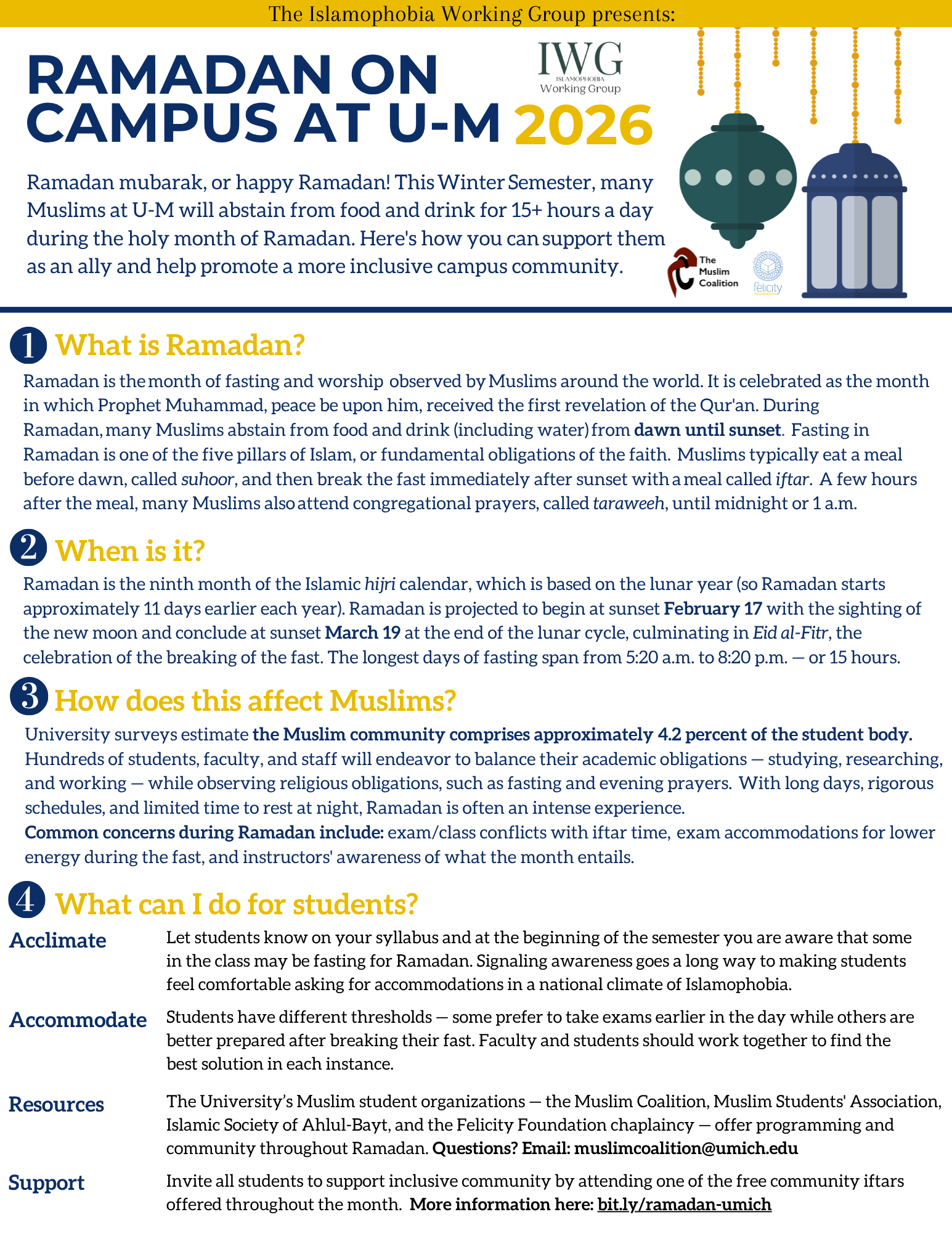
- February 18 – March 19 / Ramadan ** (Islam)
- February 18 / Ash Wednesday (Christian)
- February 18 / Lent Begins (Christian)
- February 23 / Eastern Orthodox Lent Begins (Orthodox Christian)
- March 2-3 / Purim * (Jewish)
- March 4 / Holi (Hindu)
- March 9, 11, 13, 15, 17 / Laylatul Qadr (Islam) (Odd-numbered nights in the last ten of Ramadan)
- March 11 / 23rd Night of Ramadan (Islam)
- March 15 / 27th Night of Ramadan ** (Islam)
- March 20 / Eid al-Fitr ** (Islam)
- March 21 / NowRuz *** (Interfaith/National/Bahai/Zoroastrianism)
- April 1-9 / Passover (Pesach) * (Jewish)
- April 3 / Good Friday (Christian)
- April 5 / Easter (Christian)
- April 10 / Eastern Orthodox Holy Friday (Orthodox Christian)
- April 12 / Eastern Orthodox Easter (Pascha Orthodox Christian)
- April 14 / Vaisakhi (Sikh)
- April 21 / First Day of Ridván *** (Baha’i)
- April 29 / Ninth Day of Ridván *** (Baha’i)
- April 30, May 1 & 31 / Vesak (Theravada Buddhism)
- May 1 & 31 / Vesak (Mahayana Buddhism)
- May 2 / Twelfth Day of Ridván *** (Baha’i)
- May 14 / Ascension Day (Christian)
- May 21 / Eastern Orthodox Ascension Day (Orthodox Christian)
- May 21-23 / Shavuot * (Jewish)
- May 24 / Declaration of the Báb *** (Baha’i)
- May 26 / Holy Day of Arafah** (Islam)
- May 27 / Eid-al-Adha** (Islam)
- May 29 / Ascension of Bahá’u’lláh *** (Baha’i)
- June 4 / Eid al-Ghadeer ** (Islam)
- June 16 / 1st of Muharram (Islamic New Year) ** (Islam)
- June 19 / Juneteenth (Interfaith/African American)
- June 25 / 10th of Muharram (Ashura) ** (Islam)
- July 10 / Martyrdom of the Báb *** (Baha’i)
- July 22-23 / Tisha B’Av (Jewish)
- August 4-5 / Arbaʽeen ** (Islam)
- August 25 / Birth of the Prophet Muhammad ** (Sunni Islam)
- August 25 / Birth of the Prophet Muhammad ** (Shia Islam)
- Shabbat * (Jewish) Weekly, Friday sunset to Saturday sunset
- Jumu’ah (Islam) Weekly, Thursday sunset to Friday sunset
* Jewish holy days begin and end at sundown on the first and last days listed.
** These holidays are calculated on a lunar calendar and are approximate. Muslim holidays begin and end at sundown on the first and last days listed.
*** The Bahá’í day ends and a new one begins at sunset; consequently, the day on which a Holy Day is observed begins at sunset of the day before the Gregorian calendar dates given above.
Additional Resources
- Dashain (Hindu/Nepal)
- Ganesh Chaturthi / Vinayaka Chavithi (Hindu)
- Guru Purnima Hindu/Buddhist/Jainsim
- Jewish Calendar – Fall 2025 (Jewish)
- Krishna Janmashtami (Hindu)
- Karva Chauth (Hindu)
- Maha Shivaratri (Hindu)
- Raksha Bandhan (Hindu)
- Rama Navami (Hindu)
- Vijaya Dashami / Dussehra (Hindu)
- Ugadi / Gudi Padwa / Teugu New Year (Hindu)
Institutional Resources and Support
The following units are available to offer support and guidance on accommodation requests:
Frequently Asked Questions
What types of accommodations are available for religious observance?
Accommodations can include rescheduling of exams, assignments, or classes, as well as alternative arrangements for attendance, to accommodate religious observance.
How do I request a religious observance accommodation?
To request accommodation, students should communicate their request to their instructors as soon as possible, preferably at the beginning of the semester, but need to provide at least a two-week notice. Instructors should communicate their request to their Department Chair at the beginning of the semester or as soon as possible.
What documentation is required to request a religious observance accommodation?
Students are not required to provide documentation of their religious beliefs, and faculty cannot ask any questions about if, or how, they celebrate these holidays. Requests for accommodation should be taken at face value.
What if there is a conflict between a religious observance and a mandatory class or exam?
Instructors should make every effort to avoid scheduling exams and oral presentations during the major religious days on campus (Jewish, Muslim, Hindu, etc.). If a professor or the university has scheduled such an exam or oral presentation, they must be reasonably rescheduled without academic penalty.