

8.B Resources for Faculty

8.B.1 Center for Research on Learning and Teaching

The Center for Research on Learning and Teaching (CRLT) is a central administration unit reporting to the Office of the Provost and Executive Vice President for Academic Affairs and serving all faculty at the University of Michigan. CRLT is dedicated to the support and advancement of learning and teaching at the University. Professional staff at the Center have Ph.D.'s in a variety of disciplines. They work collaboratively with faculty members, graduate student instructors (GSIs), and the academic administration to promote a University culture that values and rewards teaching, respects and supports individual differences among learners, and encourages instructional environments in which diverse students can learn and excel. The programs and services described below are designed to meet the interests and needs of faculty members at all stages of their careers. Faculty at UM-Flint and UM-Dearborn are welcome to participate in CRLT workshops, although they are not eligible for CRLT grants. In the fall of 1998, UM-Flint established the Frances Willson Thompson Center for Learning and Teaching. See the website at <www.umflint.edu/resources/centers/tclt> or call 810/767-6508. See also Section 8.B.4, “Evaluations of Teaching."

Grants to Enhance Teaching and Learning. In collaboration with the Provost's office, CRLT sponsors six grants competitions for faculty who wish to develop innovative approaches to improving teaching and learning at the University. Grants are available to fund course and curriculum development, multicultural pedagogies, interdisciplinary teaching, instructional technology, and innovative pedagogical projects. Information about specific competitions, including descriptions and application materials, is available on CRLT's website <www.crlt.umich.edu>.

Evaluation for Grants and Curriculum Revision. CRLT's evaluator works with faculty on the planning, implementation, and evaluation of education grants in areas of curricular and pedagogical innovation. CRLT staff also work with groups of faculty in departments or schools/colleges to review their current curricula, develop new curricular offerings, and evaluate the results of curricular changes.

CRLT maintains an extensive website of resources on teaching and learning. The Teaching Strategies page has links to Web documents on a variety of topics, including syllabus and course planning, multicultural teaching, grading issues, and academic integrity. Faculty can also download CRLT's Occasional Papers and other publications and get information about our grants and our current programs. For more information, see <www.crlt.umich.edu>.

Multicultural Teaching and Learning. Helping faculty create inclusive learning environments for all students is a core component of CRLT's mission. CRLT's coordinator of multicultural teaching and learning and other instructional consltants work one-on-one with individual faculty and in collaboration with departments and colleges to help them serve the learning needs of a diverse student body, infuse new content into the curriculum, and create inclusive classrooms. Multicultural services include individual consultations, campus-wide and customized workshops, discussions of curriculum revision, and a rich set of print and Web resources.

Midterm Student Feedback. Faculty can arrange for a CRLT consultant to visit one of their classes and collect feedback. The consultant speaks with the students about strengths of the course and suggested changes. The faculty member and the consultant then meet to discuss the feedback and strategize about changes and next steps. The service is completely confidential and has been rated very highly by faculty and students alike.

Instructional Seminars. During the fall and winter terms, CRLT offers a series of instructional seminars, roundtables, and book groups for the teaching faculty. Topics include what research tells us about teaching, using groups and cooperative learning, teaching for inclusion, and using instructional technology for classroom innovations. Faculty can register for seminars on CRLT’s website.

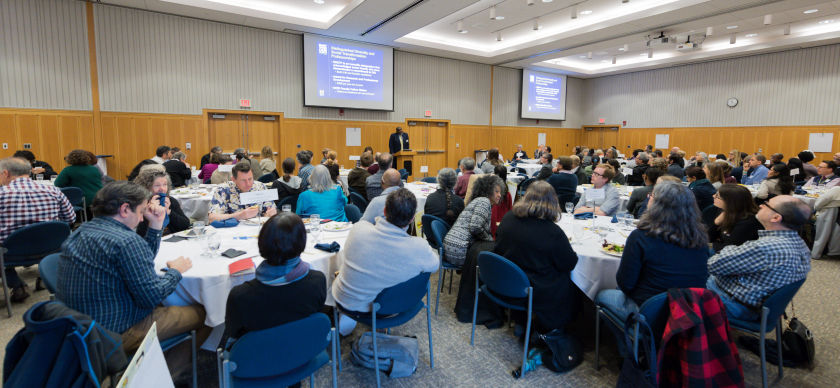
CRLT Theatre Program. The CRLT theatre program uses traditional and interactive theatre techniques to bring research findings to life on stage. The program’s performances usually focus on issues of diversity and inclusive classrooms, and they are based on a solid foundation of research on the experiences of underrepresented groups in the classroom (e.g., students of color, women in the sciences and engineering). Interactive sketches allow faculty to dialogue with the characters and each other to explore issues in more depth and develop concrete strategies to improve the climate in their classrooms. Some sketches also examine climate issues for faculty. In addition to performances, the director of the theatre program consults with faculty and conducts workshops on theatre-related topics such as role playing, stage fright, and voice projection.

Consultations on Teaching. Professional staff provide confidential consultations for individual instructors about any aspect of teaching and learning including innovative teaching strategies, classroom-related concerns, interpretation of student ratings, and ways to incorporate instructional technology into teaching.

Customized Programs for Units. In collaboration with the University’s academic programs, departments, schools, and colleges, CRLT develops customized programs and services to respond to their special needs. For example, CRLT professional staff will assist in custom designing workshops and retreats on topics of interest to faculty.

Graduate Student Instructor (GSI) Development. CRLT provides a variety of services for graduate student instructors (GSIs), including orientation programs in the fall and winter for new GSIs, a series of seminars on teaching for GSIs during the academic year, and individual consultations. CRLT also works with individual departments to help design GSI training programs that are discipline specific. In collaboration with the English Language Institute, CRLT offers a training program for graduate students who did not receive their undergraduate education in English.

Publications. CRLT publishes resource materials for the teaching faculty of the University. CRLT’s Occasional Papers present original research on student learning and provide summaries of literature and recommendations for best practice on a range of issues including learning styles, working effectively with students from underrepresented groups, teaching portfolios, and fundamentals of online teaching. CRLT also makes available a set of publications designed for GSIs or the faculty in charge of GSI training in a department. All of CRLT’s publications are available at their website.

For more information about any of these programs and services, contact CRLT at 1071 Palmer Commons, 100 Washtenaw Avenue, phone 764-0505, fax 647-3600, or e-mail <crlt@umich.edu>. See also the CRLT website at <www.crlt.umich.edu>.

8.B.2 Distance Education

Distance education is defined by the North Central Association as a formal educational process in which the majority of instruction occurs when student and instructor are not in the same place. Although many faculty members use instructional technology to allow students to do some of the work for individual courses from a distance (see Section 20.F, “Information Technology Facilities, Programs, Resources, and Support”), the role of distance education is still evolving at the University of Michigan.

Faculty who are interested in distance education should consult their department chairs and deans regarding the policies, priorities, and resources of their academic units. When questions arise about legal issues such as copyright, the Office of the Vice President and General Counsel should be consulted. See also Section 20.C, “Copyright.” On issues such as enrollment procedures and regulations, the Office of the Provost and Executive Vice President for Academic Affairs offers advice (764-9290). The Center for Research on Learning and Teaching (CRLT) provides special assistance with pedagogical issues involved in distance education initiatives. See Section 8.B.1, “Center for Research on Learning and Teaching.”

8.B.3 Edward Ginsberg Center for Community Service and Learning

Building on a long tradition at the University of Michigan, the Edward Ginsberg Center for Community Service and Learning seeks to enable faculty on the Ann Arbor Campus to integrate service into teaching and to conduct research responsive to community needs, engage students in community service and academic learning in order to promote civic participation, develop collaborative partnerships with communities, improve the quality of life in communities nationwide, and enhance the educational process.

The Center promotes "service as scholarship" through faculty activities such as:

  • Consultation and technical assistance for faculty related to community-based service learning
  • John Dewey Lecture Series
  • Faculty instructional workshops on community-based research and service-learning pedagogy
  • Faculty Instructional Grants, available to faculty members who integrate service into teaching
  • Doctoral seminar on service learning
  • Publication lending library
  • "Service-Learning Course Design Workbook" (a complimentary copy is available to any UM faculty or staff member on request)
  • Workshops preparing faculty and students for participation in the community
  • National peer-reviewed journal, the Michigan Journal of Community Service Learning (a complimentary subscription is available to any UM faculty on request)

The Center’s Faculty Council has responsibility to advise the Center on policy, planning, and program priorities. Located in a turn-of-the-century former residence near the heart of campus, the Center is a meeting place and activity center with facilities available for campus and community groups. Programs and grants are available to all faculty on the Ann Arbor Campus. For more information, visit the Center at 1024 Hill Street, the website at <www.umich.edu/~mserve>, or call 647-7402.

8.B.4 Evaluations of Teaching

Teaching evaluations can help faculty improve their classroom performance and provide important information for decisions about re-appointment, promotion, tenure, salary, and awards. (They also provide information to students to assist them in course selection.) All of the schools and colleges have teaching evaluation tools to meet these objectives. Many require faculty to distribute and collect evaluations from their students at the end of each term. Some have peer review procedures; others ask faculty being reviewed for teaching or performance to submit teaching portfolios. For information about the systems in place for a particular academic unit, faculty should check with the department chair or other administrator.

The Office of Evaluations and Examinations (E&E) administers a system of student course evaluations called Teaching Questionnaires. This system permits instructors to select questions to administer to the students in a given class from a large catalogue of choices. E&E prints and scores the students’ rating forms. Some schools, colleges, and other academic units design common core questions for use in these or other questionnaires. Reports with statistical results of the responses and all individual student comments are returned to the instructors. In some academic units, the statistical reports are also sent to the dean or chair. For more information, contact the appropriate dean, or E&E at 763-6943. See also Section 8.B.5, “Examination and Survey Services (E&E).”

The Center for Research on Learning and Teaching (CRLT) can provide information about multiple methods of evaluating teaching, including teaching portfolios and peer review. CRLT’s instructional consultants also help individual faculty interpret their student ratings reports. See also Section 8.B.1, “Center for Research on Learning and Teaching.”

8.B.5 Examination and Survey Services

The Office of Evaluations and Examinations (E&E) provides a test-scoring service for standardized tests or exams constructed by faculty. This office also handles placement tests for incoming students during orientation, and provides assistance with the design and scoring of surveys. These services are available for courses taught and students enrolled at the Ann Arbor Campus. E&E’s address is: 200 Hill Street, Ann Arbor, Michigan 48104-3297. Telephone: 763-6943. Fax: 764-4221. For information about E&E’s role in teaching evaluations, see Section 8.B.4, "Evaluations of Teaching."

8.B.6 Faculty Mentoring Handbook

The Horace H. Rackham School of Graduate Studies publishes two guidebooks: "How to Mentor Graduate Students: A Guide for Faculty in a Diverse University" and a companion handbook for graduate students, "How to Get the Mentoring You Want." Rackham acknowledges the important role mentoring plays within graduate education, and developed these handbooks to assist faculty and graduate students in forming mentoring relationships that are based on realistic goals, expectations and understandings of one another. For more information, or copies of these guidebooks, see Rackham's website at <www.rackham.umich.edu/StudentInfo/Publications>.

8.B.7 Instructional Technology

See Section 20.F, “Information Technology Facilities, Programs, Resources, and Support” and the website at <www.umich.edu/~teachtec>.

In addition, the Center for Research on Learning and Teaching provides consultation services to individuals and departments in the integration of technology into teaching, including distance education. See the CRLT website at <www.crlt.umich.edu>.

8.B.8 Michigan Learning Communities

The Michigan Learning Communities (MLC) encompass a number of programs designed to offer students a friendly, supportive, and close-knit learning community within the context of the larger University environment.

The College of Literature, Science, and the Arts (LSA) offers two four-year academic learning communities: the LSA Honors Program and the Residential College.  Other residential programs include the Health Science Scholars Program, the Lloyd Hall Scholars Program, the Michigan Community Scholars Program, the Max Kade German Residence Program, the Michigan Research Community, the Women in Science and Engineering Residence Program (see also Section 2.C), and the Adelia Cheever Program to prepare women for a leadership in a global society. 

In addition, the University offers non-residential learning communities:  the University Mentorship Program, the Undergraduate Research Opportunity Program (see also Section 2.C), and the Comprehensive Studies Program. 

These programs provide faculty with a wide range of contexts and opportunities to interact with students outside of the traditional classroom. For more information, contact the Office of the Associate Dean for Undergraduate and Graduate Education in LSA, at 764-0320 or visit the Michigan Learning Communities' website for an overview <www.lsa.umich.edu/mlc/overview.asp>.

8.B.9 Student Organizations

There are over 700 departmental clubs, professional societies, and other student organizations at Michigan. Students’ experiences in these organizations are greatly enhanced by faculty involvement as advisors, resource persons, and guest speakers. Contact the departmental administrator regarding student groups affiliated with that area and the Office of Student Activities and Leadership (763-5900 or <www.umich.edu/~salead>) for information on other student organizations.


Faculty Handbook: Teaching and Faculty Interactions with Students:


Faculty Handbook | Table of Contents | Appendices | Acronyms | Help | Index |Home